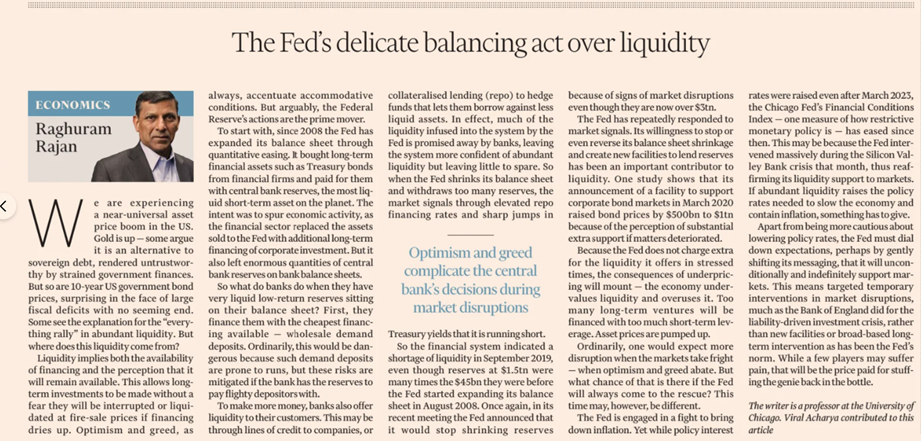
Letter — The Fed’s delicate balancing act over liquidity
Scan of the published letter (self-hosted image).
Raghuram Rajan (“The Fed’s delicate balancing act over liquidity”, 18 November) is rightly attentive to the
risks surrounding liquidity conditions. However, two points in his argument merit clarification in light of the
balance-sheet mechanics of modern central banking.
Professor Rajan suggests that, following Quantitative Easing, banks were left holding “liquid low-return
reserves”, which they then financed with “wholesale demand deposits”. The resulting depositor-flight risk
could only be managed “if the bank has the reserves to pay flighty depositors with”. These interpretations,
while intuitively appealing, do not align with how reserves and deposits are actually created.
When the Federal Reserve purchases an asset from a bank, the operation is an asset swap: the bank’s Treasuries
fall and its reserve balance at the central bank rises by the same amount. Nothing occurs on the liability side
of the balance sheet. Deposits do not increase, the bank does not raise new funding, and nothing is being
“financed”. Total assets, liabilities, and equity are unchanged; only the composition of assets is different.
More broadly, attributing today’s abundant liquidity — and therefore, asset-price inflation — solely to the
Federal Reserve risks overlooking the role of the private sector. Commercial banks remain the primary engine of
liquidity creation, generating new deposits whenever they extend credit. Central bank reserves, by contrast,
circulate only within the banking system and do not directly enter the private sector. Any account of
asset-price dynamics that focuses exclusively on the Fed’s balance-sheet expansion misses this crucial
distinction.
This point was emphasised in Fed Governor Christopher Waller’s July speech on why the Fed’s balance sheet is
structurally larger today than before the global financial crisis. Two of its three major liability components
— currency in circulation and the Treasury General Account — are determined largely by public demand for notes
and coins and by the Treasury’s cash-management practices, and are not decisions of the Fed. The third
component, bank reserves, is the instrument used under the “ample reserves” regime to implement monetary
policy efficiently. These combined forces imply that the Fed’s balance sheet will remain considerably larger
than its pre-2008 norm irrespective of QE.
Misunderstanding central banking operations — whether by suggesting that banks “finance” reserves or by
attributing asset-market behaviour solely to QE — anchors the public debate in false premises. Until the
balance-sheet mechanics are properly understood, discussions of inflation, financial stability, and the role
of central banks will continue to misfire.
Piers D Watson Sydney, Australia